Buying guide, Uniforms
Chef Coat Fabrics Explained: What Actually Works in an Indian Kitchen
Ask ten chefs what a chef coat should be made of and you will get ten answers, most of them shaped by whichever coat last made them miserable at 3pm on a Saturday. After stitching chef uniforms for hundreds of Indian kitchens since 2018, from patisserie cold rooms to tandoor sections that run past 45 degrees, we have narrowed the decision down to four variables: blend, weight, weave and finish.
Blend: cotton, poly-cotton or performance
100% cotton is the most breathable option and the traditional choice. It absorbs sweat, feels soft against skin, and is what most classically trained chefs ask for first. The trade-off is real: cotton creases hard, shrinks on the first few hot washes, fades under industrial detergent, and takes a long time to dry in a humid Delhi or Kolkata monsoon.
65:35 poly-cotton twill is what we recommend to roughly eight out of ten clients. It keeps enough cotton for comfort, adds polyester for shape retention, colour-fastness and quick drying, and survives commercial laundering far longer. For a 40-cover restaurant replacing coats once a year instead of twice, the maths is not close.
Performance blends, poly-cotton with a moisture-wicking finish or mesh vent panels under the arms and across the upper back, are worth the premium for hot sections and for chefs who work the pass in front of guests. We build these with the vent panels hidden inside the yoke so the coat still looks formal from the front.
Denim and blended satin are style decisions. A washed denim chef jacket photographs beautifully in an open kitchen and has become a signature look for cafes and modern Indian restaurants, but it is heavier and warmer. Use it for pass, bar-kitchen and barista-adjacent roles rather than for the grill.
Weight: the GSM question
GSM (grams per square metre) is the number most people forget to ask about, and it is the one that decides whether a coat feels cheap. Below 160 GSM a white coat goes translucent under kitchen lighting and shows the t-shirt underneath, which no photographer will thank you for. Above 240 GSM the coat starts fighting the chef in July.
- 180 to 200 GSM for hot line, tandoor and grill sections.
- 200 to 220 GSM for general brigade use, the safest default.
- 220 to 240 GSM for pastry, cold kitchen, air-conditioned open kitchens and executive coats where drape and structure matter more than airflow.
Weave and construction details that survive service
Twill weave beats plain weave for a chef coat: it drapes better, hides light creasing and resists abrasion at the cuff and elbow. Beyond the cloth, the details that decide a coat's lifespan are unglamorous: double-stitched armholes and side seams, bar-tacked stress points, a reinforced thermometer pocket on the left sleeve, and buttons that do not melt. We use knotted cloth buttons or press studs rather than cheap plastic; both survive the hot wash that plastic does not.
The fastest way to make a uniform look expensive is not to add more branding. It is to get the weight, the collar and the cuff right, and then put a small, well-placed embroidered crest on it.
Colour, contrast and branding
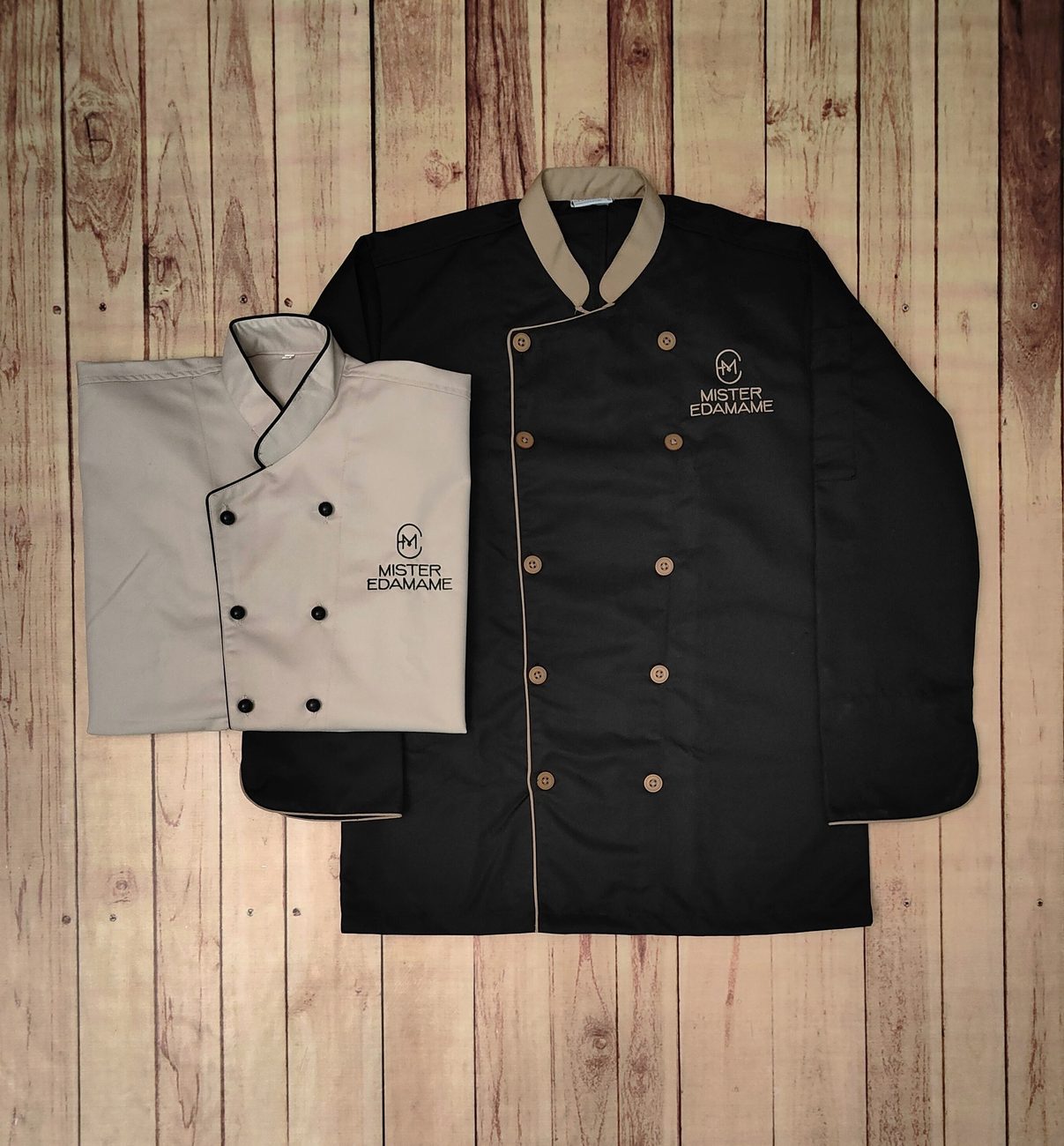
Colour is where the brand shows up. Contrast piping along the mandarin collar and placket, a coloured inner facing that shows when sleeves are rolled, and a chest crest in a single embroidery colour will do more for your identity than a large printed logo across the back. For restaurant uniforms we usually embroider rather than print on chef coats, because embroidery survives the wash cycle that kills prints.
If you run multiple sections, colour-coding is worth doing deliberately. One client runs white for the executive chef, ink-blue for sous and section chefs, and black for the commis brigade, so a guest looking into the open kitchen can read the hierarchy without knowing a thing about kitchens.
What we would order for a new 60-cover restaurant
Three coats per chef in 210 GSM poly-cotton twill, mandarin collar, press studs, thermometer pocket, contrast navy piping and a chest crest in matching navy. Two chef caps and two aprons per person on top. One white executive coat with a heavier 230 GSM cloth and a tailored fit for press photographs and guest interactions. Fabric labels with wash-care instructions stitched in, because the laundry is where uniforms actually die.
Get fabric swatches before you decide
We send physical swatches: feel the difference between 190 and 220 GSM before you commit a whole brigade to it. Message us on WhatsApp at +91 98213 34906 with your kitchen sections and headcount, and we will send a fabric recommendation, mockups and pricing, usually the same day.